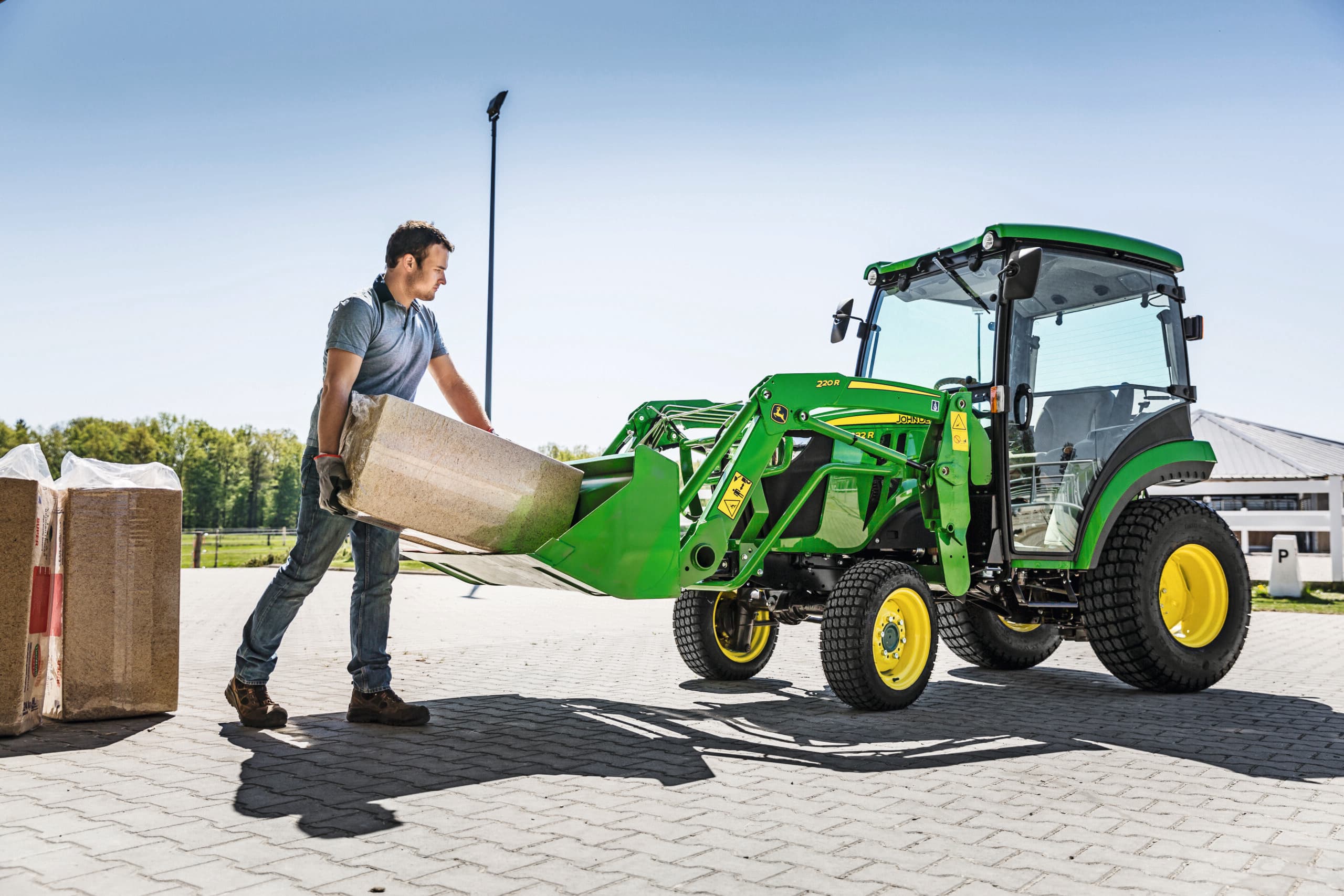
Sub-Compact vs. Compact Tractor: Which Fits Your Property
9/29/2026

A sub-compact tractor is John Deere's 1 Series. It handles smaller properties and everyday mowing, loader, and snow work. A compact tractor is the 2 Series. It adds horsepower and lift for more acreage and heavier attachments. Your land and your heaviest job decide which one fits.
If you've started shopping for a tractor, you've probably noticed John Deere splits its smallest models into two categories: sub-compact and compact. The names sound close enough to consider them the same, but the tractors underneath them are built for different jobs. Here's how to decide between the two for California properties.
The short version: horsepower, size, and how much weight the hydraulics can lift.
John Deere's 1 Series sub-compact tractors run about 22 to 24 horsepower. They're smaller and easier to maneuver, and they're priced to make sense for a homeowner or small-acreage property. The 2 Series compact tractors step up to roughly 24 to 37 horsepower on a heavier frame, with hydraulics built to handle bigger loader and backhoe work all day. Four-wheel drive and power steering come standard on both series.
Neither one is "better." They're sized for different properties and different workloads, which is exactly why the decision comes down to your land, not just the spec sheet.
Acreage is the first thing to consider when deciding between sub-compact and compact tractor models.
A sub-compact tractor like the 1023E or 1025R is a strong fit for properties up to a few acres. Think of a large residential lot, a hobby farm, or a small equestrian property. It's nimble enough to work around fences, garden beds, and outbuildings without feeling oversized.
Once you're managing several acres or more, a compact tractor like the 2025R or 2032R has the horsepower to keep up. That's especially true if you're dealing with pasture, drainage work, or a driveway that needs regular grading. If your property keeps growing past that, the 3 Series is worth a look too. (The 3025E is one example.) But for most sub-compact-vs-compact decisions, acreage alone will point you toward one series or the other.
Acreage tells you the size of the job. The task type tells you the size of the tractor you need to do it.
Sub-compact tractors are built for the jobs you'll be doing all year: mowing, light loader work, box-blade grading, tilling a garden, and clearing snow off a driveway. They're also a smart pick if storage space is tight. A smaller frame fits in a standard garage bay or a modest shed.
Compact tractors earn their keep on heavier, more frequent work. Think brush hogging overgrown ground, backhoe digging, moving round bales, or running a rear tiller through packed soil for hours at a stretch. Pairing the tractor with a loader and backhoe combo? Here's what's typically included in a compact tractor package, so you know what you're comparing.
The 1025R is the most popular tractor in Belkorp Ag's sub-compact lineup, and for good reason. It's sized for a homeowner or small-acreage farm but still handles a loader, backhoe, or mower deck without feeling underpowered. The 1023E is the more budget-friendly option in the same class, built for straightforward mowing and loader work.
Both share the traits that make sub-compacts easy to live with. A step-through platform. Fender-mounted controls you can reach without leaning. A tight turning radius for working around trees, fences, and garden beds.
The 2025R and 2032R are strong entry points in the John Deere 2 Series lineup, and the jump in capability shows up fast. The hydrostatic transmission, with TwinTouch forward and reverse pedals, makes loader work and tight-quarters maneuvering easier than it sounds. You get a lot more attachment options too, from box blades and rear tillers to backhoes rated for real digging.
Running a small farm? Managing pasture? Doing enough loader and backhoe work that a sub-compact feels stretched thin? This is where you'll want to start looking at the 2 Series and up.
| Feature | Sub-Compact (1 Series) | Compact (2 Series) |
|---|---|---|
| Horsepower | 22–24 hp | 24–37 hp |
| Best-fit acreage | Up to a few acres | Several acres and up |
| Drivetrain | 4WD standard | 4WD standard |
| Typical jobs | Mowing, light loader work, snow removal, gardening | Brush hogging, backhoe digging, heavier loader work, pasture upkeep |
| Storage footprint | Fits most garage bays and sheds | Needs a bit more clearance |
| Example models | 1023E, 1025R | 2025R, 2032R |
If you're still weighing it, here are the key points to consider.
That's really what this decision comes down to. Walk your property. List the three or four tasks you'd use a tractor for most, and bring that list in to Belkorp Ag. We'll match it to a model, sub-compact, compact, or a step up into the 3 Series, instead of you guessing at a spec sheet alone.
For light-duty work on a few acres (mowing, tilling a garden, occasional loader use), yes. Once the work turns to regular pasture upkeep, heavier loader jobs, or backhoe digging, a compact tractor is the better fit.
Not always. Attachments are matched to a tractor's lift capacity and hitch category, so a compact tractor typically runs larger, heavier-duty implements than a sub-compact can handle safely.
You already have it. Four-wheel drive and power steering come standard on John Deere's 1 Series sub-compacts and on the 2 Series compact tractors. What separates the series is horsepower, frame size, and hydraulic lift capacity, not the drivetrain.
That's common, and it's exactly the kind of call worth making in person or over the phone rather than by spec sheet. Bring your task list, and we'll help you land on the right size.
Ready to see these tractors side by side? Explore Belkorp Ag's compact utility tractor lineup or get in touch with a specialist to talk through your property.