What is the Difference Between John Deere M and R Series?
Updated Oct. 26, 2026
That one letter at the end of a model number is one of the most common questions we get on the lot. Here's how to read it, what it costs you, and what it buys you.
How John Deere Model Numbers Work
John Deere uses the model number to tell you three things: size, power, and feature level.
On the traditional format, the first digit is the family or size class. The next digits are engine horsepower. The letter at the end is the feature level. A 5075M is a 5 Series utility tractor, roughly 75 engine horsepower, at the M feature level.
You will see both formats on dealer lots and in used listings for years to come. Compact models still use the older style, such as 4052M and 4075R. Most 6 Series models now use the newer style.
E, M and R: What Each Letter Means
The letters run in alphabetical order, and so does the feature level.
E — Essential. The value trim. Open station, mechanical controls, straightforward transmissions. E models are built for seasonal use, smaller acreages, and jobs that do not require a cab. Examples: 3032E, 5075E, 6105E.
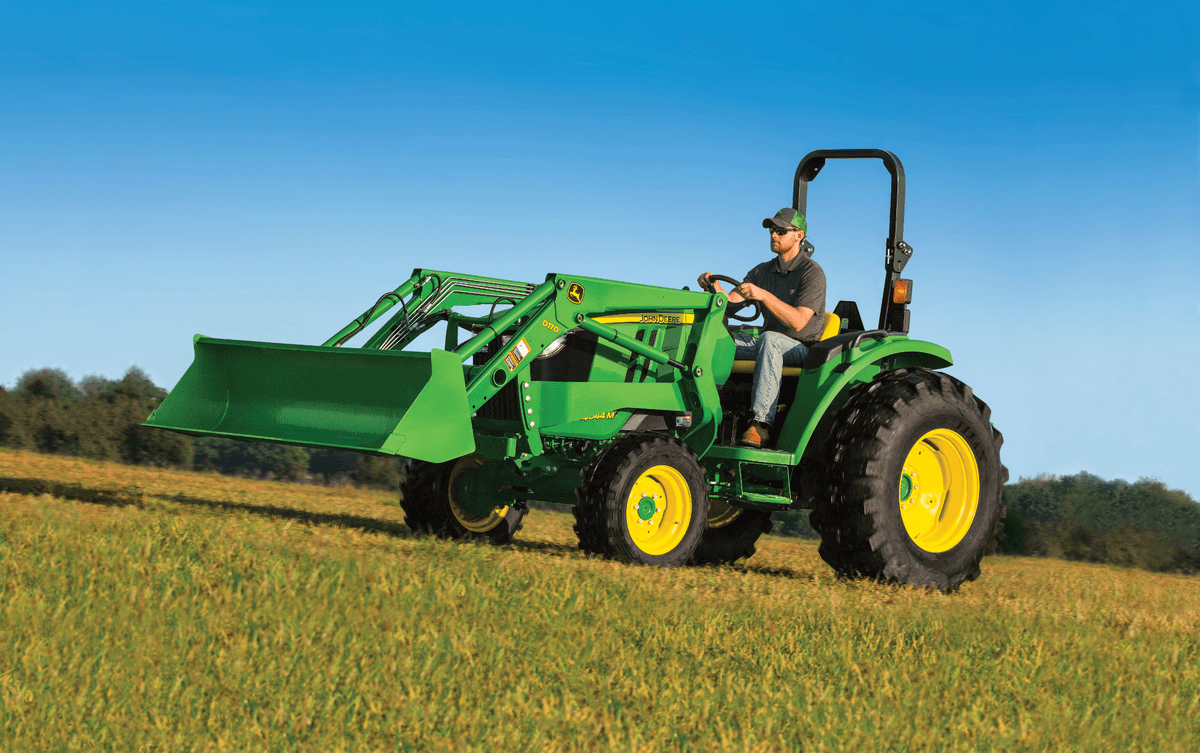
M — Mid. This is the most common choice on working farms. More horsepower options than E, more transmission choices, cab availability on the larger families, and enough hydraulic capacity for loader work and mid-size implements. Examples: 4052M, 5105M, 6M 140.
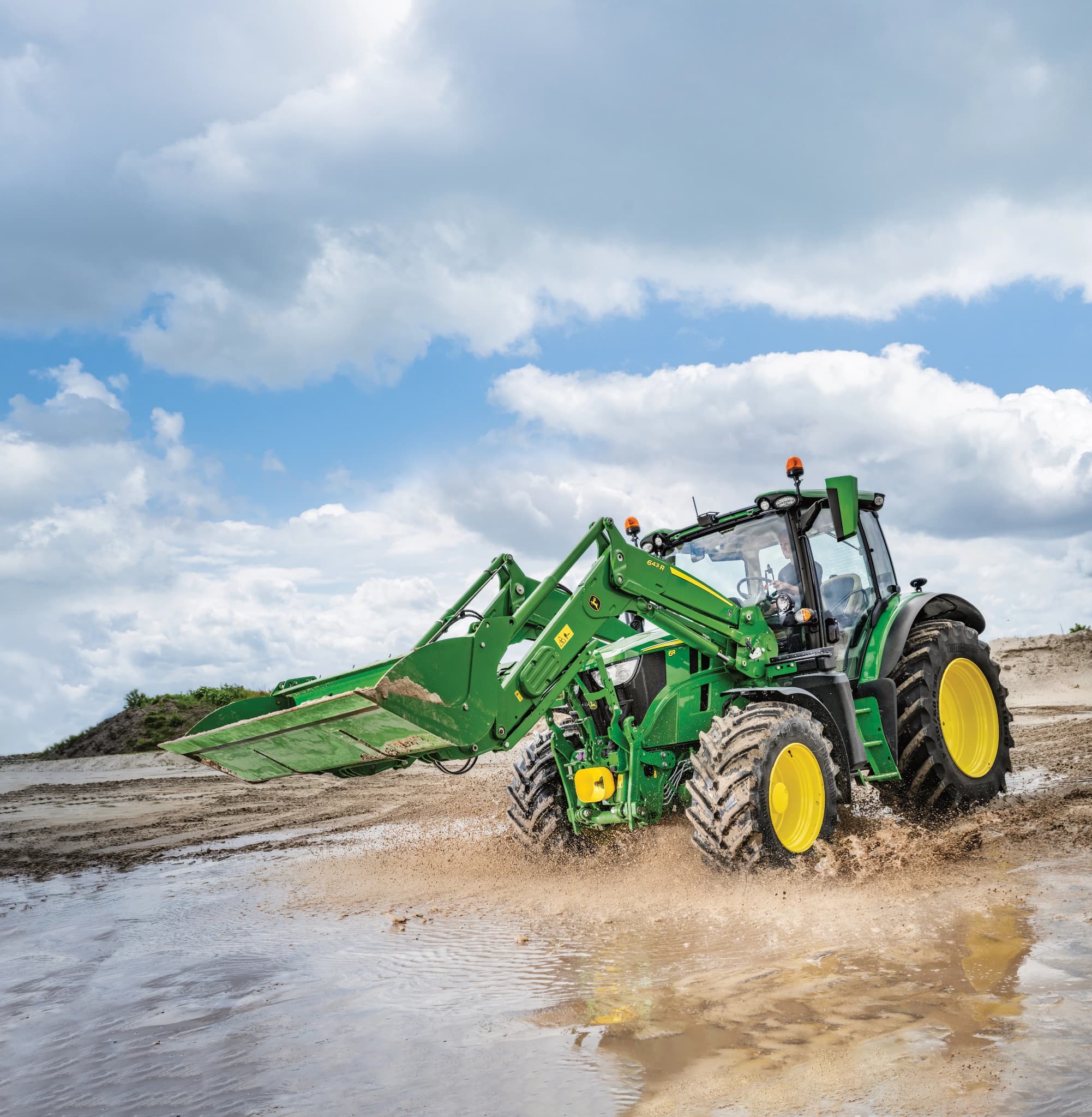
R — Premium. The top trim below the specialty lines. Cab comfort, premium transmissions, electro-hydraulic hitch and remote controls, better lighting, and the highest horsepower ratings in the family. Examples: 4075R, 6R 250.
One point worth clearing up: the letter describes equipment level within a family, not overall size. A 6M is a bigger, more powerful tractor than a 4R, even though R sits higher in the alphabet. Pick the family first, then the letter.
M vs. R at a Glance
Availability varies by family and model year. Confirm the exact configuration with your dealer before you buy.
4M vs. 4R: Compact Utility Tractors
The 4 Series is where most first-time buyers meet this question. These are compact utility tractors for acreages, landscapers, vineyards, stables, and municipal crews.
4M Series covers roughly 44 to 66 horsepower across the 4044M, 4052M, and 4066M. You get a turbocharged diesel, an open operator station, a Category 1 three-point hitch, and loader compatibility. It is a straightforward machine built for mowing, loader work, box blading, and hauling.
4R Series covers roughly 44 to 75 horsepower across the 4044R, 4052R, 4066R, and 4075R. The 4075R sits at the top and gives the 4 Series more power than the M lineup offers. The R adds a climate-controlled cab option, LED work lights, hitch assist, electro-hydraulic hitch control, and a more refined operator station.
The practical difference is time in the seat. If you are running two or three hours at a stretch in reasonable weather, the 4M does the job and leaves budget for attachments. If you are working through California summer heat, winter rain, or long mowing routes, the 4R cab changes the day.
6M vs. 6R: Utility and Row-Crop Tractors
The 6 Series is the high- volume line for working row-crop and dairy operations, and it is where the M and R gap is widest.
6M Series runs from about 95 to 250 engine horsepower. It is built around visibility, maneuverability, and a practical operator station. That makes it a good match for loader work, tight yards, and hay ground. It also suits orchard and vineyard alleys, where a shorter wheelbase earns its keep.
The decision usually comes down to hours per year. Loader tractors and second tractors tend to land on the 6M. Primary tillage, planting, and long-haul road work tend to justify the 6R.
What About the 1 Through 6 Series?
Not every family offers both letters, and the lineup has shifted in recent years.
Ranges and availability change with each model year. Check current inventory rather than assuming a letter is available in the family you want.
How to Choose Between M and R
Four questions settle most of these decisions.
How many hours will you run it? Under a few hundred hours a year, the M feature level is usually the better value. Past that, cab comfort and transmission quality stop being luxuries and start affecting how much you get done.
Do you need a cab? This is the single biggest driver of the price gap. Dust, heat, cold, and spray work all push toward a cab. If you need one, price the R against a cab-equipped M in your family. The gap is often smaller than buyers expect.
Will you run precision ag? If guidance, section control, or documentation are part of the plan, the R level integrates more of it from the factory and costs less to equip than retrofitting.
Who else operates it? Machines shared across several operators or seasonal help benefit from the simpler M controls. Machines with one dedicated operator justify the R.
Talk It Through With Belkorp Ag
Spec sheets only get you so far. The right answer depends on your acres, your crops, your hours, and your budget. That is a conversation worth having in person.
Give us a call or stop by your nearest Belkorp Ag location and talk it through with someone who knows the lineup.
Frequently Asked Questions
Is the R Series better than the M Series?
It is better equipped, not better built. Both share the same core engineering and durability standards. The R adds comfort, control, and horsepower at the top end. The M is the better buy when you do not need those features.
What does the letter at the end of a John Deere model number mean?
It is the feature level. E is essential, M is mid, R is premium. The letters rise alphabetically with the equipment level.
Which John Deere families offer both M and R?
In the current U.S. lineup, the 1 Series, 4 Series, and 6 Series all offer both M and R models.
Is there a 5R tractor?
Not in the current U.S. lineup. The 5 Series is offered in E and M configurations today. Used 5R models still come through dealer inventory.
Does the M or R Series hold its value better?
Resale depends on hours, condition, configuration, and local demand more than on the letter. Cab-equipped and precision-ready machines generally have a wider pool of buyers.
Can I add features to an M Series later?
Some, but not all. Cabs, transmissions, and electro-hydraulic hitch controls are built-in decisions. Lighting, telematics, and some attachments can be added after the fact.