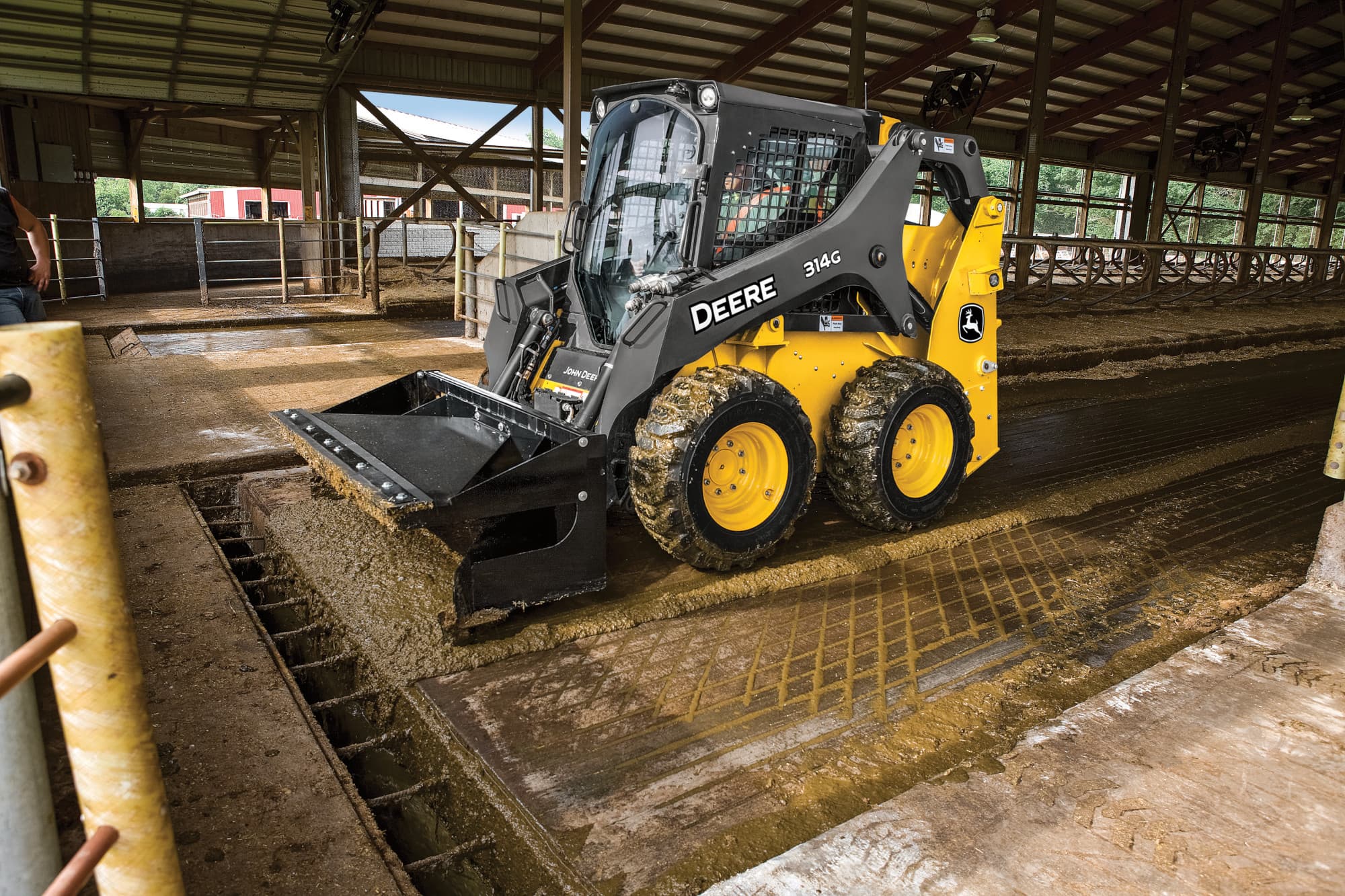

Skid Steer Attachments for Clearing Brush and Overgrowth
9/21/2026

Clearing brush with a skid steer takes a few attachments working in order. A rotary cutter knocks down standing brush. A mulching head grinds limbs and small trees into mulch. A root rake pulls out rootballs. A stump shredder removes stumps. A grapple hauls off what is left.
Plenty of Central Valley crews are surprised to learn that a skid steer can clear brush as well as a compact tractor. The difference is the attachments on the front of the machine. With the right ones, you can cut down dense overgrowth and keep it from coming back. But brush clearing is not the same job as mowing. Here are the attachments that do the work, in the order you would use them.
Mowing maintains ground that is already under control, and it usually takes a lower-power rotary cutter or a separate machine like a ZTrak or lawn tractor. Clearing reclaims ground that got away from you, either through neglect or because you never had the right tool for the job.
Brush clearing also means cutting bushes and saplings, not just overgrown grass. Thicker material needs equipment that will not bog down or overheat. That calls for more power, and it starts with a rotary cutter.
Rotary cutters are common on compact tractors. For skid steers and compact track loaders, John Deere builds three separate front-mounted families: RC, RS, and RX. The RC60B, RC72B, and RC78B are the standard-duty RC models. The RS72 is an extreme-duty brush cutter rated for heavy brush and trees up to seven inches in diameter. The RX84 covers the wider end of the range.
Front mounting changes how the work feels. The cutter sits where you can see it, and you steer it with the loader arms instead of dragging it behind you.
These cutters have the power to knock down thick grass, brush, and small trees. The RC72B cuts a 72-inch swath and handles saplings up to four inches in diameter. It runs on popular skid steer models including the 318G, 320G, 324G, 330G, and 332G. On an overgrown commercial lot or a new home site, that first pass sets up every step after it.
Burning brush is not an option on most California job sites, where state and local rules are strict, so most crews mulch instead.
A mulching head mounts on the front of a skid steer or compact track loader (CTL). Inside is a heavy, hydraulically driven rotor with steel teeth that spins at high speed. As you push forward, the teeth grab material and grind it against an internal cutter bar. Standing trees, brush, and woody debris come out as fine mulch.
Capacity depends on the model, so check the rating before you plan a job around it. The MH60D and MH72D remove trees up to eight inches in diameter and stumps up to 12 inches. The SM60 is a standard-flow option built for mid-frame machines under 75 horsepower, and it handles material up to five inches. The MK76 has the widest cutting width of the group at 76 inches.
Mulching also feeds the material back into the property. The limbs and brush you grind can go straight onto garden beds and planting areas.
Cutting and mulching solve half the problem because roots and rootballs stay in the ground. As long as the rootball is there, what you ground down can come back. Blackberry and willow are two of the worst for that.
To keep brush from returning, pull the roots with a grapple. John Deere builds grapples for different materials, including rock and scrap. For roots, you want a root grapple, also called a root rake. A root rake has teeth or tines all the way around instead of a flat shovel bucket on the bottom. That lets it dig into the soil and lift stubborn roots out. The RR72, RR78, and RR84 root rakes are built for that job.
Larger trees leave stumps behind, and the John Deere SS30 Stump Shredder is built to handle them. It uses a low-speed, high-torque auger to remove stumps from eight to 28 inches in diameter in a single pass. Larger stumps come out with multiple bores.
One note on fit. The SS30 is built for mid- and large-frame machines: the 320G, 324G, 330G, and 332G skid steers, plus the 325G, 331G, and 333G compact track loaders. A small-frame machine that runs a rotary cutter will not run this one.
Stumps are worth removing for two reasons. A stump left in place can sprout again in spring. It is also hard to work around, and most job sites need a flat, clear surface before construction starts.
After the cutting, mulching, and grinding, the debris is still on site, and it has to go somewhere. A rock or scrap grapple turns your skid steer into a debris-removal machine.
A scrap grapple has the usual grapple teeth on top and a flat shovel on the bottom. Small limbs and rocks that would slip through an open grapple stay put in this one. Sizes run from the GR66B up through the GS84B, so you can match the attachment to the machine you already own.
Skid steers and compact track loaders run attachments on hydraulic power, not a PTO. Your machine's hydraulic flow and rated operating capacity decide what it can turn. Both John Deere and Belkorp Ag list compatible models with each attachment. Check that listing before you buy, and ask your local Belkorp Ag specialist if you are not sure.
Not sure which attachments your job needs? Not sure what your current skid steer can run? Bring your machine model and your acreage to your local Belkorp Ag, and our team will help you sort it out. Stop by any of our eight California locations.
Yes, with the right attachments. Front-mounted cutters and mulching heads give you better sightlines and more precise control than pulling an implement behind a tractor. Hydraulic flow, not PTO horsepower, sets the limit on what your machine can run.
A rotary cutter knocks material down and leaves it in pieces on the ground. A mulching head grinds it into fine mulch you can reuse. Cutters move faster over open brush. Mulching heads handle standing trees and clean up as they go.
If you want the ground to stay clear, yes. Blackberry and willow regrow from the rootball, and a cut stump can sprout in spring. A root rake pulls rootballs out, and a stump shredder removes what is left above them.
Rarely. Most clearing work moves through two or three tools: a cutter or mulching head first, then a root rake or grapple for cleanup. Ask your Belkorp Ag specialist which ones your machine can run before you commit to a plan.