5 Orchard and Vineyard Jobs the Wacker Neuson SM100 Handles Well
Have you ever had issues fitting your equipment between tight orchard and vineyard rows? You’re not alone. But that’s the exact issue the Wacker Neuson SM100 aims to fix.
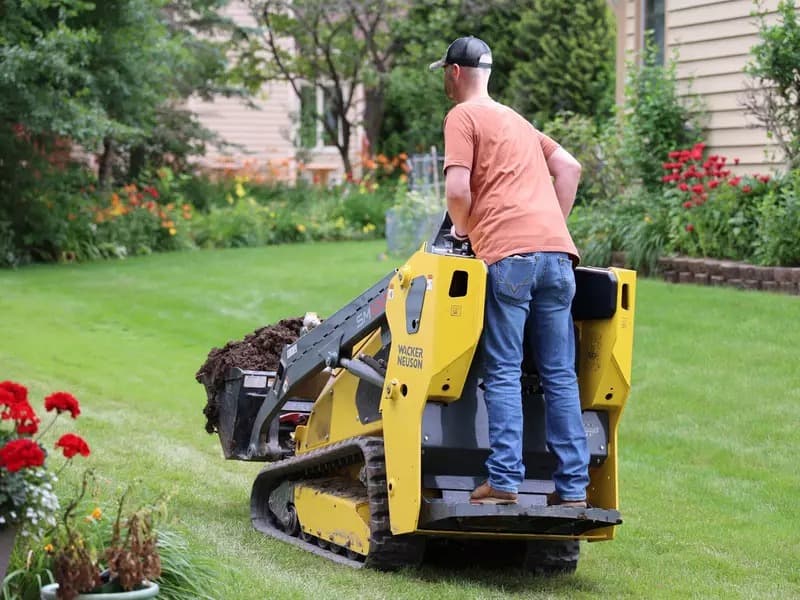
The Wacker Neuson SM100 is a stand-on mini track loader built for tight rows and soft ground. In California orchards and vineyards, it earns its keep on five jobs: hauling bins and supplies, drilling holes for trellis posts, clearing prunings, maintaining row middles, and working in spaces a tractor cannot reach.
Imagine this scenario: it's February, the ground is still holding water, and you have a job that won't wait. You need to move a stack of bins, set 20 replacement stakes, or pull a winter’s worth of prunings out of the middles. Your tractor can do all three. The question is what it leaves behind in the row when it does.
That’s the gap a mini track loader fills. The SM100 is not a replacement for your tractor; it’s a second machine that takes the jobs where a tractor is heavier, wider, or slower than the work actually requires.
Here are five jobs the Wacker Neuson SM100 handles well where a compact tractor may struggle.
Why a Mini Track Loader Fits Row-Crop Ground
Like most compact track loaders, the SM100 mini track loader spreads its weight across two wide rubber tracks instead of four tires. The SM100 puts 4.1 psi on the ground, and the whole machine weighs 3,300 pounds. For comparison, a person walking exerts roughly the same pressure through the heel of a boot.
The other important number is width. The SM100 measures 35.5 inches across without a bucket. That gets it down a young vineyard row, through a barn door, and into corners where a compact tractor has to back out and come at it from another angle.
1. Hauling Bins, Stakes, and Supplies Across Soft Ground
The SM100 moves material into the block when the ground is too wet for heavier equipment. Rated operating capacity is 998.7 pounds at 35% tip load, or 1,426.4 pounds measured at 50%. Tip load is 2,855 pounds.
That is enough for a pallet of stakes, a load of amendments, or empty bins going out ahead of harvest. Travel speed tops out at 5.2 mph, which is slow on a road but fine inside a block.
The real advantage is timing. Work you would normally postpone until the ground dries becomes work you can do this week. In a wet North Coast winter, that flexibility is worth more than raw power and capacity.
2. Drilling Holes for Trellis Posts and Vine Stakes
An auger attachment turns the SM100 into a post-hole digging machine that fits inside the row easily. The auxiliary hydraulic flow is 13 gpm with a relief pressure of 3,045 psi, which runs standard mini skid steer attachments without a separate power source.
Replant work is where this pays off. Setting a handful of posts in an established block usually means walking a tractor and auger down a row that was not designed for it. A narrower machine gets to the hole, drills it, and backs out without touching the trellis wire or the neighboring vines.
The stand-on platform helps here too. The operator steps off, checks the hole, sets the post, and steps back on. On a tractor, that same sequence means climbing down from a seat every time.
3. Clearing Prunings and Brush Out of the Middles
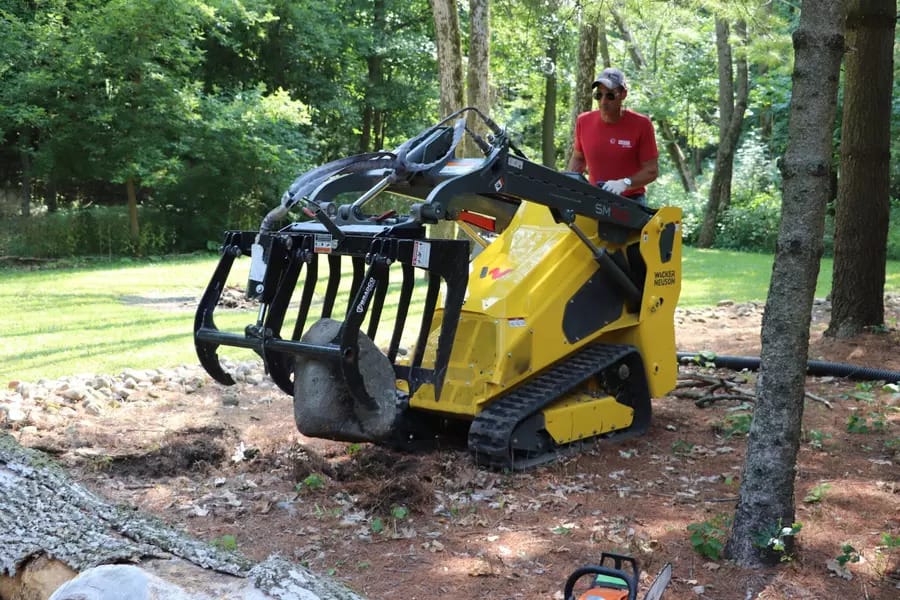
A grapple attachment lets the SM100 pick up prunings and move them out of the row in one pass. Winter pruning leaves a lot of wood on the ground, and hand-clearing it is slow, expensive labor.
The SM100 grabs a pile, carries it out, and stacks it for chipping or burning. The hinge pin height is 85.7 inches, and the bucket dump height at full lift is 62.8 inches, so it can dump over the side of a trailer or a high-sided truck.
4. Keeping Row Middles and Berms in Shape
Attachments like brush cutters and tillers turn the SM100 into a floor-management machine for the middles and the berm. Cover crop knockdown, weed control, and light soil work all sit inside its range.
The 24.7-horsepower Yanmar diesel is a three-cylinder, turbocharged, Tier 4 Final engine that puts out 63 lb-ft of torque. That is a modest engine by tractor standards.
For growers moving away from chemical floor management, mechanical options are getting more attention across California. A smaller machine that can make more frequent passes without packing the soil fits that shift well.
5. Working Where a Tractor Will Not Fit
Width is one of the major advantages of the SM100. At 35.5 inches, the SM100 goes through gates, shop doors, and the space between a fence and the end post. Ground clearance is 7.8 inches, and the track on the ground measures 43 inches.
Yard and shop work counts too. Cleaning out a barn, moving pallets in a storage building, loading a trailer, or handling material around the winery are all jobs that a full-size machine makes awkward. At 3,300 pounds, the SM100 can also be towed behind a pickup without a heavy-duty setup.
What the SM100 Will Not Do
A mini track loader is not a tractor, and treating it like one can lead to disappointment.
The right way to look at it is as an addition to a fleet that already has a tractor in it. The tractor does the heavy, sustained, implement-driven work. The mini track loader takes the tight, wet, short-run jobs that often slow a tractor down.
Wacker Neuson SM100 Specifications
Specifications from the Wacker Neuson SM100 technical data page. Configurations vary, so confirm the build with your dealer.
See it in Person at Belkorp Ag
Belkorp Ag now carries the Wacker Neuson SM100 across our California locations. Talk to your local Belkorp Ag dealer about how it would fit alongside the tractors you already run and what attachments make sense for your operation.
Find your nearest Belkorp Ag location or contact our service team to schedule a walkaround.
Frequently Asked Questions
Can a mini skid steer replace a compact tractor in an orchard?
No. A mini track loader has no PTO or three-point hitch, so it cannot run tractor implements. It complements a tractor by taking on short-run material handling, auger work, and cleanup in tight or wet conditions.
How much does the Wacker Neuson SM100 weigh?
The SM100 has an operating weight of 3,300 pounds. That is light enough to be towed behind a pickup and light enough to limit compaction on soft orchard and vineyard ground.
Will the SM100 fit down a vineyard row?
At 35.5 inches wide without a bucket, it fits most established vineyard row spacings and many young plantings. Measure your narrowest row and your gate openings before you buy.
What attachments does a mini track loader use?
Standard mini skid steer attachments run off the SM100 auxiliary hydraulics at 13 gpm. Common orchard and vineyard choices include buckets, augers, grapples, brush cutters, pallet forks, and tillers.